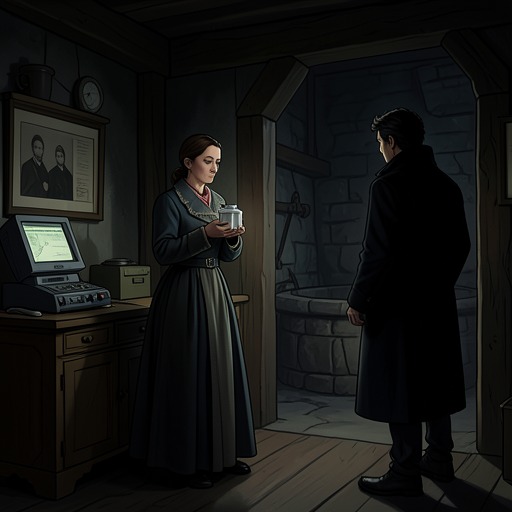
“Ding Dong Dell, Pussy's in the Well” Clue
Hallowe'en PartyThe “Ding Dong Dell, Pussy's in the Well” clue is a nursery rhyme whose scattered recurrences help Hercule Poirot uncover that Olga Seminoff did not simply run away: her body had been hidden in a sealed well in Quarry Wood. The clue works by moving between hearsay, a child's speculation, and a detective's inference. What initially sounds like local fancy becomes a specific lead when Poirot connects the rhyme to the missing au pair and to Michael Garfield's reluctance to show Miranda Butler a well.
The rhyme as local knowledge
The clue first becomes explicit when Poirot asks what happened to the foreign girl who was said to have run away. Mrs Goodbody answers, “Didn't go far, in my opinion. 'Ding dong dell, pussy's in the well.' That's what I've always thought, anyway.” Her response does not present proof: it is an opinion, expressed through a familiar rhyme. But it resists the simple assumption that the girl left the area, and gives Poirot a compact image that can be tested against the landscape and the known disappearance.
The rhyme's ordinary, almost comic form helps conceal the seriousness of its implication. A cat in a well belongs to the world of children's verse; a missing young woman in a well belongs to a murder investigation. Mrs Goodbody's phrasing joins the two without explaining how literally she means it. Poirot can therefore treat the remark neither as a reliable witness statement nor as meaningless chatter. It is a suggestion whose value depends on whether other details converge with it.
Miranda's version and the physical well
A later exchange gives the rhyme a second, more complicated context. Miranda warns that one should not believe everything a witch says, and says she does not believe a child ever fell into the well; perhaps a cat once fell in and drowned. She then repeats, “Ding dong dell, pussy's in the well,” gets up, and leaves. Her explanation treats the rhyme as a possibly fanciful story about an animal, not as a report of a murder. Yet her conversation has also involved asking about a wishing well and urging Michael Garfield to take her there. His refusal gives Poirot a reason to attend to the well rather than dismiss the subject as children's talk.
Poirot tests the implication directly, asking Michael, “Ding dong dell,” said Poirot, thoughtfully. “One believes what one wants to believe, Michael Garfield. Was she right or was she not right?” Michael confirms that there is a well and that it is sealed up. He allows that it may have been dangerous, but distinguishes it from the wishing well in Mrs Goodbody's story: in his account, the wishing place was a beech tree halfway up the hillside, where people once walked around three times backwards and made a wish. The distinction matters. The story of a wishing well may be mistaken, but a real sealed well remains in the landscape, and Miranda's interest in it remains significant.
From suspicion to a testable inference
The clue does not immediately settle the case. In a later discussion, Inspector Raglan says that a piece of definite evidence will soon be available and cautions that there may have been a mistake. Poirot reformulates the possibility as “Ding dong dell, no pussy in the well?” The altered rhyme captures the unresolved question: the well may be present, but is the missing girl actually in it? His interlocutor calls the idea a surmise. Poirot replies that disappearances usually reduce to a small number of explanations, including that the person has gone away with someone or is dead; other possibilities are far-fetched. This is his reasoning, not yet the physical confirmation he is waiting for.
Poirot later explains how the separate observations became a location. Miranda had asked about a wishing well and pressed Michael to take her there, while Michael refused. Poirot then asked Mrs Goodbody where the disappeared girl had gone; her rhyme made him sure that the girl's body was in the wishing well. He found that the well was in Quarry Wood, on an incline not far from Michael's cottage. The rhyme thus directs attention to a place, while Miranda's question and Michael's refusal help make that place relevant. Neither element alone supplies the full proof; together they give Poirot a focused hypothesis about where Olga's body might be found.
What the clue reveals in retrospect
In his account of the crimes, Poirot identifies Olga's removal as part of a plot connected to the codicil. She knew about it and was to be made a scapegoat, suspected of forgery; Lesley Ferrier was paid to produce a forged document and was later killed. Poirot says that he knew Olga's body had to be hidden somewhere in the neighbourhood, but did not know where until Miranda's interest in the well and Mrs Goodbody's rhyme pointed him toward it. The clue therefore contributes not just an answer to the question of whether Olga ran away, but a link between her disappearance and the larger conspiracy.
Its meaning sharpens through contrast. Miranda imagines a drowned cat and questions a witch's story; Mrs Goodbody gives the rhyme as something she has always thought; Michael distinguishes the actual sealed well from a wishing tree; and Poirot turns these fragments into an inference that can be checked. The nursery verse is not itself evidence that names a killer or explains the forged codicil. Its importance is narrower and more concrete: it preserves, in a memorable form, the possibility that the missing girl never left the neighbourhood. Once connected to the sealed well in Quarry Wood, that possibility helps lead from rumour to the concealed body and exposes the limits of the claim that Olga simply ran away.